
Gray native loops reach 25.918× VM speedup
The same 100-million-iteration sum ran in a 210.511 ms median with native lowering and 5,456.099 ms with the Gray JIT disabled.
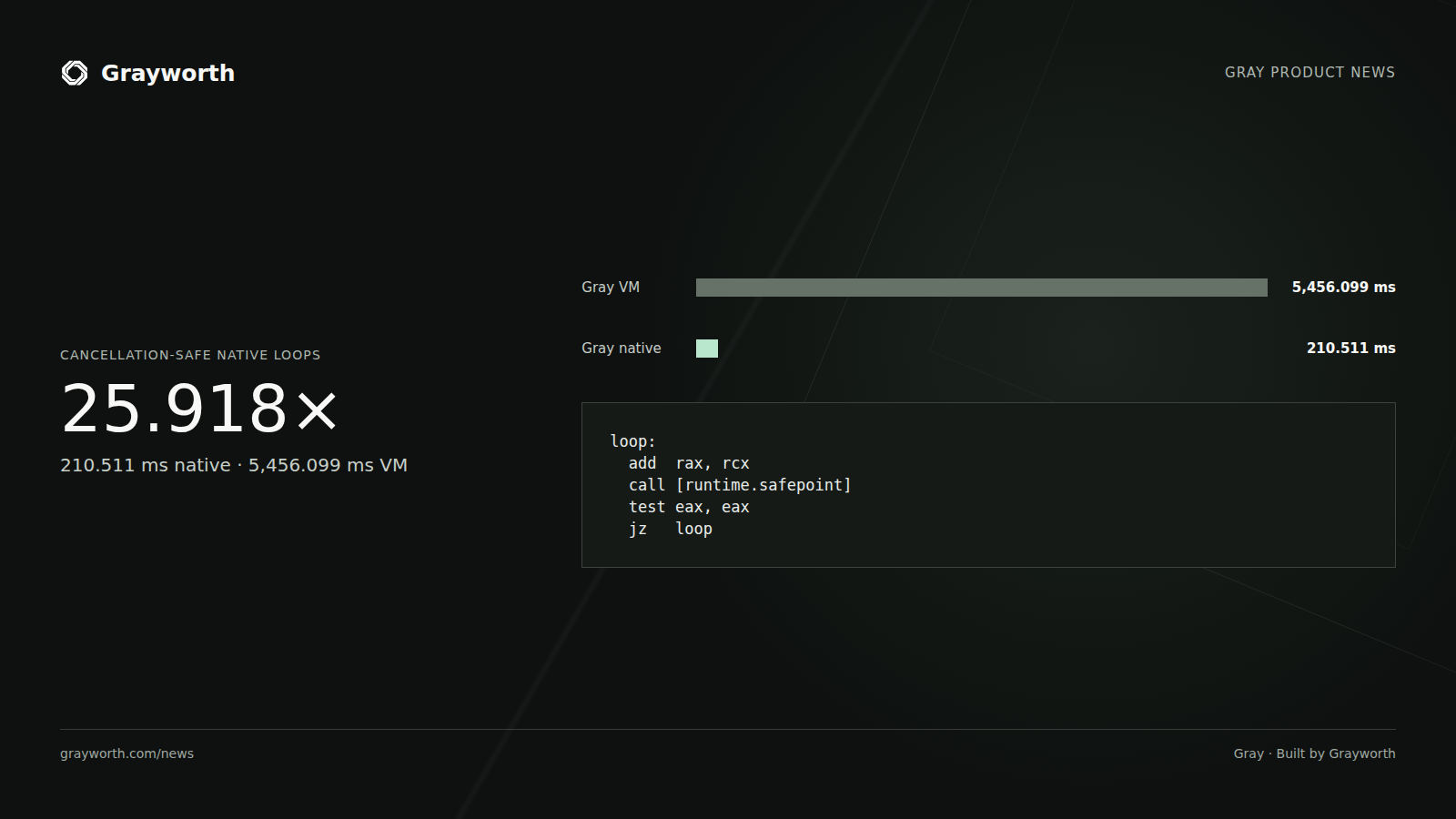
Native loops now preserve Gray semantics
Gray’s x86-64 backend can lower typed loops, local mutation, integer comparisons and control flow into machine code through the documented native runtime ABI. Unsupported functions continue through verified VM fallback.
The backend does not accept a loop merely because it can encode a backward branch. Every generated backedge calls the runtime’s stop-token safepoint and returns a structured cancellation exit when work should stop.
That contract keeps native execution inside Gray’s structured task model. A hot loop can lose bytecode dispatch without becoming an uninterruptible island inside the process.
The same loop ran 25.918 times faster
The diagnostic computed an identical 100-million-iteration integer sum in fresh, CPU-pinned Gray processes. One policy enabled native lowering; the other disabled the JIT and executed the same function through the VM.
Seven accepted samples produced a 210.511 ms native median and a 5,456.099 ms VM median. Dividing those medians yields a 25.918× end-to-end improvement for this workload.
The measurement includes a stop-token safepoint on every loop backedge. The reported gain therefore includes the cost of retaining cancellation rather than benchmarking an unsafe stripped-down loop.
Cancellation is part of the differential
A dedicated test starts a typed loop with a nine-quintillion-iteration ceiling, waits 20 milliseconds, requests cancellation and requires a CancelledError. The test passes with native lowering enabled and with interpreter-only execution.
Live JIT, Live VM, Static JIT and Static VM produce the same result. ASan and UBSan builds exercise native relocation, generated frames, structured exits and the spawned-loop cancellation path.
The runtime ABI identifies exit kind, ABI version, source function and instruction. Native calls therefore preserve source-located errors and cancellation identity as execution returns to the VM.
The benchmark marks backend progress
This is a Gray-native-versus-Gray-VM diagnostic. It does not compare Gray with C++, Rust, Go or another compiler, and it does not claim that every Gray application becomes 25.918 times faster.
The result demonstrates that VM dispatch was the dominant cost in an eligible sustained loop and that Gray’s backend can remove it without changing the cancellation contract.
Broader value lowering, more native call paths and additional platform backends remain active compiler work. Each expansion keeps the same differential rule: native execution must match the VM before its speed is accepted.
What was measured
Gray measured one identical typed integer-sum loop in fresh CPU-pinned processes, once with native lowering and once with the JIT disabled. Seven accepted samples supplied the reported medians, while the generated backedge retained the stop-token safepoint and the cancellation suite ran in both native and VM configurations.
The measurement isolates bytecode-dispatch cost for that eligible loop and reports an end-to-end median differential. It does not measure a complete application, establish a speedup for arbitrary Gray code, or compare Gray with another implementation language.
How to read this result
This result shows that the bounded x86-64 backend can remove VM dispatch from the stated loop without dropping Gray's cancellation behavior. It is evidence of one verified compiler capability, not a claim that native lowering is complete or that every workload should be expected to have the same ratio.
The canonical formal record is [GW-2026-0004](/publications/gw-2026-0004). That publication is the source for the accepted samples, fixture definition, runtime ABI context and the limitations of the diagnostic.