
Gray ships compiler-hidden PostgreSQL continuations
A 30-second database qualification delivered 7,961.48 requests/s with p99 4.60 ms, 164 simultaneous suspended handlers and zero general task workers.
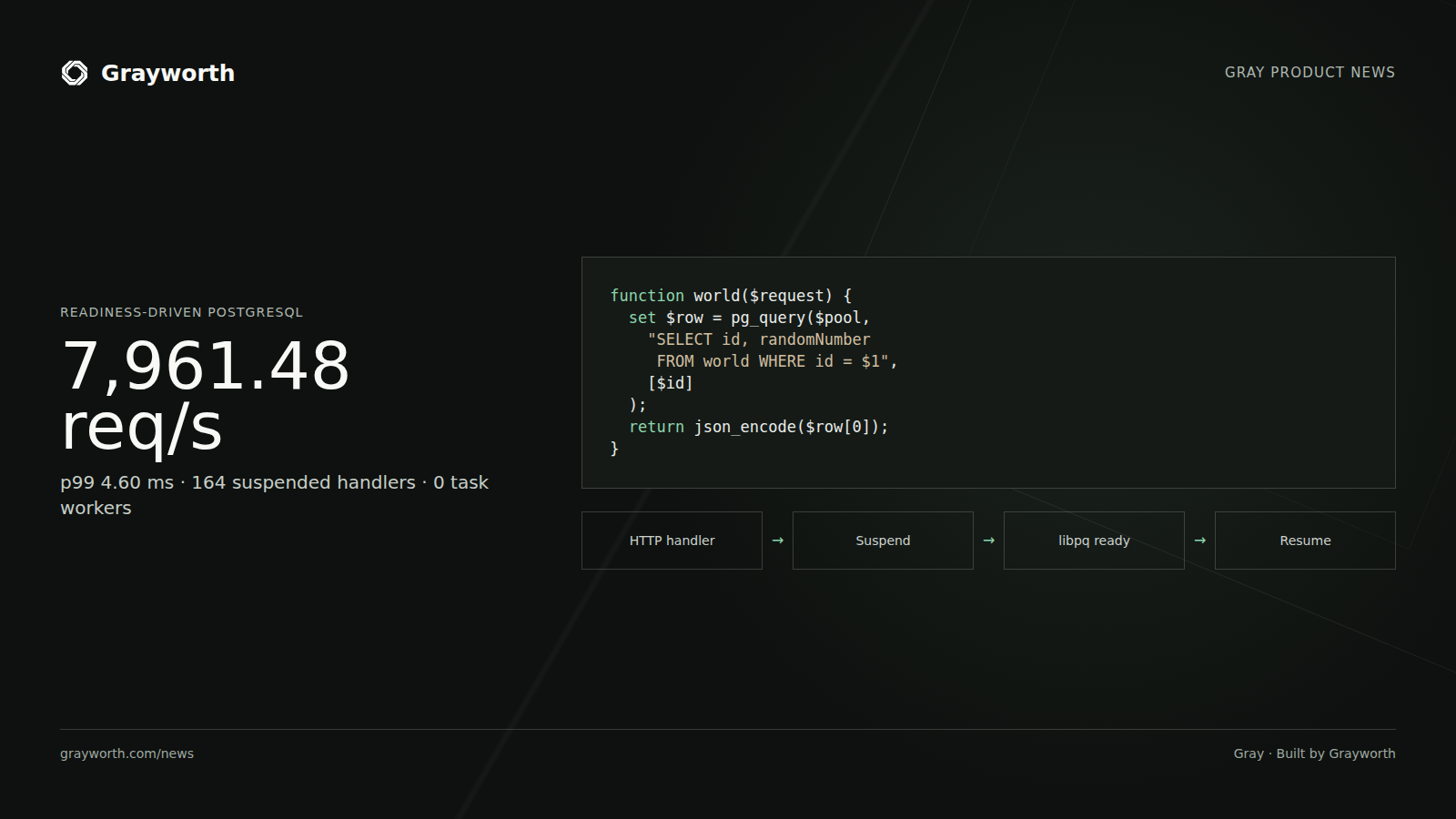
Database waits disappear from handler syntax
Gray HTTP handlers can now call PostgreSQL in direct source order while the compiler and runtime preserve the suspended continuation. The source reads like a synchronous query, but the reactor is released whenever the database socket is not ready.
The application does not maintain a pending-request map, write a polling loop or assign every database wait to a general worker. Gray captures the handler state, associates it with the nonblocking libpq operation and resumes the exact continuation when the socket advances.
The result is a server model in which direct code and cooperative I/O are the same product feature rather than competing programming styles.
Readiness runs through the whole connection lifecycle
Connection creation uses PQconnectStart and PQconnectPoll rather than blocking the process. Query execution sends work nonblockingly, consumes input only when the database socket is ready and returns the connection to the pool after the complete result is decoded.
When all pool connections are occupied, new work waits in the Gray scheduler instead of failing immediately or consuming task-worker capacity. A cancellation discards the active connection and replaces it safely before another request can inherit uncertain protocol state.
Typed query failures resume through Gray’s normal error path. Live, Static and Adaptive modes preserve the same language behavior.
The first qualification cleared 8,000 requested
The Static fixture used PostgreSQL 16, a pool of 64 connections, four wrk2 threads and 256 persistent HTTP connections. At 8,000 requested requests/s, Gray achieved 7,961.48 requests/s, or 99.519% delivery.
Corrected p50 was 1.43 ms, p99 was 4.60 ms and p99.9 was 8.74 ms. The sampler observed as many as 164 simultaneously suspended handlers and no general task workers.
After the run, active tasks and continuations returned to zero. RSS and file-descriptor counts remained within the gate’s declared limits.
Failure behavior shipped with the fast path
The protocol suite exercises overlapping database handlers in Live and Static modes, typed errors after suspension, independent HTTP/2 multiplexing, automatic 404 and 500 responses, and Adaptive replacement while an old handler remains in flight.
Cancellation tests verify that unfinished database work cannot leak a connection back into the pool. Sanitizer builds cover the same ownership path, and the optimized suite proves the result through the actual HTTP reactor.
Real service capacity will still depend on query cost, database placement, schema, pool size and topology. What changed in Gray is the architecture: one waiting query no longer owns the HTTP reactor.
What was measured
Gray measured the declared Static PostgreSQL fixture for 30 seconds with PostgreSQL 16, 64 pooled connections, four wrk2 threads and 256 persistent HTTP connections. The result records achieved delivery, corrected latency, suspended-handler count, task-worker use and the post-run return of active tasks and continuations to zero.
That fixture demonstrates the readiness and continuation path under its stated load. It does not predict query latency for another schema, prove database capacity beyond the test topology, or imply that every blocking dependency can be made nonblocking by this mechanism.
How to read this result
This result is a runtime architecture and qualification claim: Gray can suspend the named PostgreSQL handler path without assigning its waits to general task workers. The evidence is the fixture, protocol suite and resource observations described here; the claim is not a universal throughput figure for PostgreSQL applications.
The canonical formal record is [GW-2026-0003](/publications/gw-2026-0003). Use that publication for the declared test configuration, artifact references and formal result rather than relying on the headline alone.